
Finding the best nearshore staff augmentation companies is not just about comparing hourly rates. The right provider should have the technical skills you need, a reliable pool of developers, clear communication, and a team that can work well with your existing developers.
For this list, we looked at providers that offer staff augmentation or team-extension services and compared factors such as technical expertise, team size, location, experience, flexibility, and track record.
There are hundreds of software development companies offering nearshore engineering services, but not all have the same experience with long-term team extension.
To create this list, we evaluated providers based on factors that matter when choosing a nearshore staff augmentation partner, including:
Rather than focusing on company size alone, the list prioritizes providers with documented experience helping businesses add engineering capacity and integrate external developers into existing teams.
The best provider is not necessarily the one with the lowest rate or the largest developer pool. What matters is whether the company can supply the right people and make it easy for them to work with your existing team.
When comparing nearshore staff augmentation companies, look at:
A good comparison looks at the whole engagement, not just the developer's hourly rate. Nearshore staff augmentation sits between building everything internally and handing a project over to an external provider. Our guide to in-house development vs outsourcing explains how these approaches differ.
Headquarters: Estonia and Poland
Best for: Companies looking for flexible nearshore staff augmentation and long-term team extension.
Netcorp is a nearshore software development company specializing in IT staff augmentation, custom software development teams, and custom software development. With engineering hubs in Poland and Estonia, the company helps businesses expand their in-house teams with experienced developers who integrate directly into existing workflows. Its flexible engagement model allows companies to scale teams up or down while maintaining control over project management and delivery.
Netcorp focuses heavily on staff augmentation and team extension rather than treating it simply as one service among many. Its published material also emphasizes structured onboarding and flexible team scaling.
Real client experience: Netcorp's published case studies show how its team-extension model has been used to solve different technical challenges. One high-performance transaction platform handled thousands of requests per second and reduced transaction latency by 40%, while a low-latency video platform was built to serve 200,000+ concurrent users.
Independent client feedback provides another perspective. Netcorp's Clutch profile includes verified client feedback, including a review describing how its team helped expand software-development capacity for an electric-vehicle charging project and adapted quickly as requirements changed.
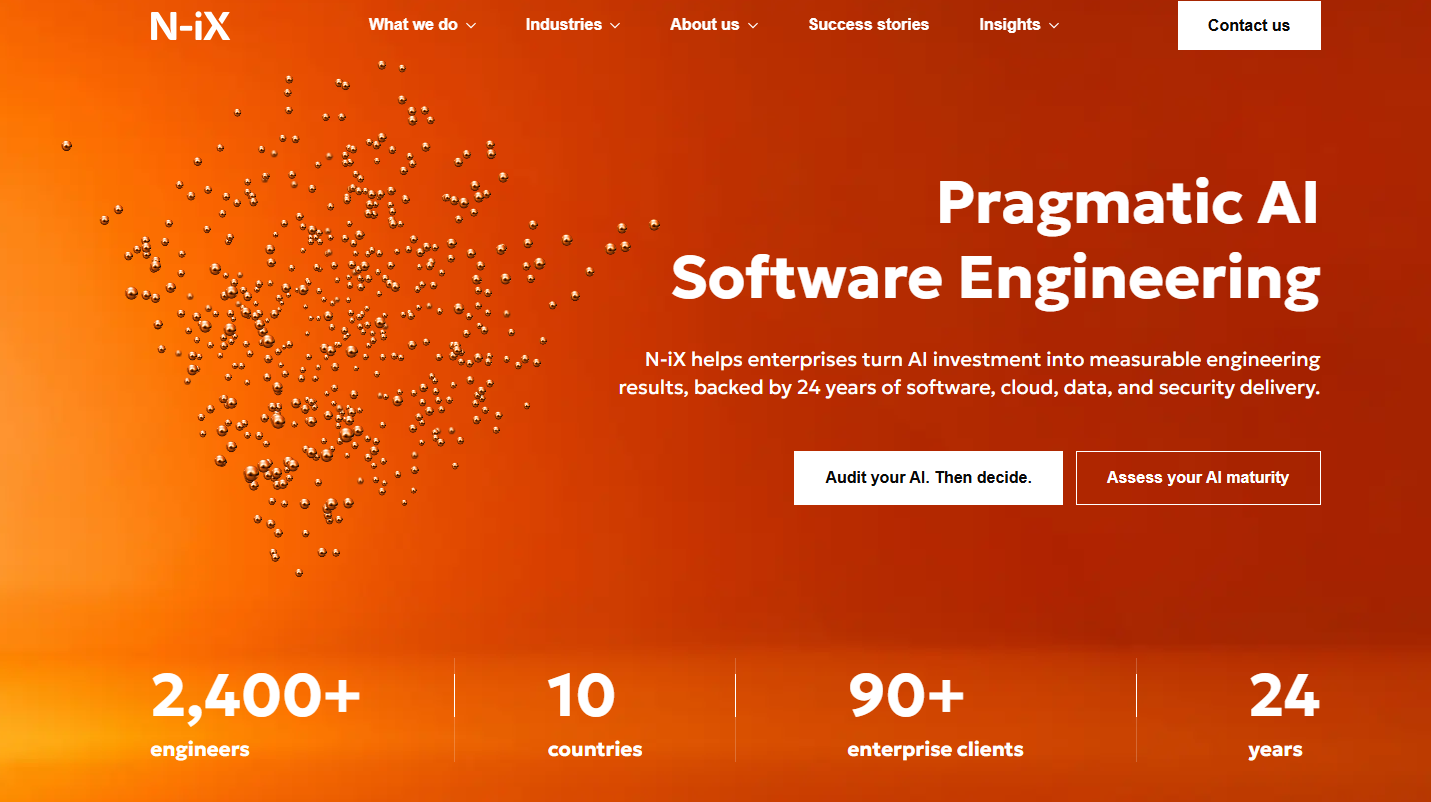
Best for: Enterprise businesses that need to scale large engineering teams
N-iX provides staff augmentation and team extension services, with engineering centers across Europe and Latin America. Its model allows clients to communicate directly with extended developers while N-iX handles recruitment, HR, retention, and related administrative support. N-iX currently reports an internal pool of more than 2,400 technology specialists.
N-iX has a relatively large engineering operation and offers several engagement models, from direct staff augmentation to managed teams. Its European model emphasizes integrating engineers into an established client's development process.
Real client experience: N-iX's published case studies include a global retailer where its team helped create a unified Azure-based pricing platform and introduced a CI/CD process that reduced the software development cycle from four weeks to one day. The engagement lists Team Extension among the services delivered.
Best for: Businesses looking for long-term technology partnerships.
Future Processing provides nearshore staff augmentation, dedicated development teams, and software consulting. Its model is designed around integrating engineers into clients' existing teams while supporting longer-term software development and digital transformation initiatives.
Future Processing's positioning places considerable emphasis on long-term collaboration rather than short-term access to individual developers. This makes it more relevant to companies expecting an extended engagement.
Real client experience: Client feedback published through GoodFirms describes Future Processing providing staff augmentation for a transport data platform, with Java and Angular developers supporting the client's internal development teams. The client specifically noted the speed at which the developers became productive. Another review describes staff augmentation for a parking-services platform involving API modernization, application development, data aggregation, and analytics work.
Best for: Companies that need to scale development teams quickly.
Scalo offers IT staff augmentation, team extension, and dedicated software development teams. Its services are designed to help companies add engineering capacity without relying entirely on lengthy local recruitment processes.
Scalo combines staff augmentation with broader software engineering and technology services, which can make it suitable for companies that need additional developers but may also require specialist technical support.
Real client experience: Published project information for Scalo includes a staff-augmentation engagement with a NASDAQ-listed fintech company working on credit-risk assessment. The project involved scaling services, modernizing legacy systems, and expanding technical capabilities while maintaining delivery speed.
Best for: Enterprise IT projects requiring flexible team extension.
Britenet provides IT staff augmentation, nearshore development, consulting, and managed services. It works across sectors including banking, insurance, telecommunications, healthcare, and the public sector.
Britenet combines software engineering with consulting and managed services. That broader model can be useful for organizations that need more than individual engineering resources.
Real client experience: Britenet publishes case studies covering organizations including AerCap, EF Education First, and financial-services companies. Its client page describes projects involving digital transformation, payment processing, Salesforce modernization, data warehousing, and other enterprise systems.
For example, Britenet's AerCap project focuses on supporting the aviation-leasing company's IT transformation, while its client feedback describes Britenet's teams working across multiple delivery centers.
Best for: Large-scale enterprise digital transformation projects.
Ciklum provides team extension, dedicated development teams, and digital engineering services for organizations with complex technology requirements. Its current case-study portfolio includes projects across financial services, healthcare, retail, AI, IoT, and other industries.
Ciklum is particularly relevant for companies that need engineering teams embedded deeply into existing product or R&D organizations rather than working as a completely separate external vendor.
Real client experience: Ciklum's published eToro case study describes a long-term engineering partnership that began in 2016. 14 teams and 55 specialists were embedded across eToro's product engineering, SRE, and architecture functions, working within the company's engineering organization across seven domains.
Ciklum also has independently verified client feedback describing development teams of up to 20 specialists operating as an extension of the client's existing team.
Best for: Organizations seeking nearshore engineering combined with IT consulting.
Avenga provides IT staff augmentation, dedicated engineering teams, software development, and technology consulting. Its model covers projects from product strategy through ongoing engineering support.
Avenga combines engineering delivery with consulting services, which can be useful for organizations that need technical specialists as well as support with broader technology initiatives.
Real client experience: A verified Clutch case involving Radium Capital describes Avenga developing a Salesforce-based loan collection management application. The client worked with a five-person core team including a solution architect, Scrum Master, developers, QA specialists, and UX practitioners. The client said Avenga's team felt like an extension of its internal team and helped plan the decommissioning of an unstable legacy system with too many manual processes.
Best for: Companies looking for scalable engineering teams and long-term team extension.
Intellias provides software engineering, dedicated teams, team augmentation, and nearshore delivery. Its published work spans industries including financial services, transportation, retail, healthcare, and telecommunications.
Intellias has documented experience moving from relatively small team-augmentation engagements into much larger engineering organizations. Its case studies provide useful evidence of how an extended team can evolve as a client's requirements grow.
Real client experience: In a published case study, Intellias initially supported BrainStorm with a small development team and later expanded the relationship into a software development center with five project teams totaling more than 50 senior IT professionals. The original engagement began as staff augmentation before expanding into broader product development responsibilities.
Best for: Companies that need flexible engineering capacity and close integration with existing teams.
Vention provides staff augmentation, dedicated teams, and bespoke software development. It works with companies across industries and uses Europe-based engineering locations, including Poland, Slovakia, Lithuania, and Bulgaria, for clients looking for closer working-hour overlap.
Vention's staff augmentation model is built around placing engineers directly into client teams. It also provides options to scale staffing based on changing project requirements.
Real client experience: Vention's published Thomas International case study documents a staff-augmentation engagement that began with two engineers and later expanded to 14 team members over two years. A five-person pod then worked on legacy-product modernization and delivered six major refinements in nine months, compared with one update per year previously.
Best for: Businesses with technically complex or high-performance software requirements.
ELEKS provides software engineering and technology consulting services, with published work covering areas such as enterprise software, SaaS, distributed systems, cloud, mobile applications, real-time systems, and high-load platforms.
ELEKS is particularly relevant when the engineering challenge involves performance, scalability, testing, or technically demanding software rather than straightforward development capacity alone.
Real client experience: ELEKS has published a performance-testing case involving a California-based high-tech image-search startup whose system needed to search through millions of images in under a second. ELEKS developed a custom testing framework covering accuracy, latency, throughput, load, and stress testing to identify performance bottlenecks and prevent regressions.
Choosing a nearshore staff augmentation company is easier when you compare the details that will affect your project, not just the quoted rate.
Look at:
Before making a decision, you can also use our guide to questions to ask a software development company.
There is no single provider that will be the best fit for every business. The right choice depends on your technical requirements, team size, timeline, budget, security requirements, and preferred working model.
Netcorp is particularly relevant for companies looking for senior developers in Estonia and Poland and a team-extension model built around working with an existing in-house team. Larger providers such as N-iX, Ciklum, and Intellias may be more suitable for organizations that need broader engineering capacity, while companies looking for a mix of engineering and consulting may prefer providers such as Avenga or Britenet.
The most useful comparison is therefore not simply which company is cheapest, but which provider has the right technical expertise, delivery location, communication model, onboarding process, security practices, scalability, and evidence of previous work.
For companies considering Netcorp specifically, the next step is to review its client case studies and compare the documented project experience with the requirements of your own development team.
Compare technical expertise, developer quality, communication, onboarding, security, flexibility, case studies, and client reviews.
Yes. They can work alongside your existing developers using the same tools, processes, and communication channels.
Look for a clear client challenge, the team or skills provided, the solution, and evidence of the outcome.
It can be, but costs vary by developer experience, technology, location, team size, and engagement length.
This gives you a proper ending without making you spend another three hours researching competitors. Your article already establishes the list and selection criteria; now it needs to finish with useful buyer guidance and a concise CTA.


Paavo Pauklin is a renowned consultant and thought leader in software development outsourcing with a decade of experience. Authoring dozens of insightful blog posts and the guidebook "How to Succeed with Software Development Outsourcing," he is a frequent speaker at industry conferences. Paavo hosts two influential video podcasts: “Everybody needs developers” and “Tech explained to managers in 3 minutes.” Through his extensive training sessions with organizations such as the Finnish Association of Software Companies and Estonian IT Companies Association, he's helped numerous businesses strategize, train internal teams, and find dependable outsourcing partners. His expertise offers a reliable compass for anyone navigating the world of software outsourcing.


Comprehensive web application development, including front-end, back-end, and full-stack.
User interface and user experience design services to create intuitive, engaging, and functional digital products.
Cloud infrastructure setup and automation for scalable, efficient software delivery using DevOps methodologies.

Comprehensive quality assurance services, including test automation, manual testing, performance testing.
