
Building an AI-powered product requires more than adding a chatbot or using an existing model. Businesses need partners who can turn AI ideas into reliable solutions that improve processes, analyze data, and scale.
Poland has become a major European technology hub, but choosing the right AI development company can be challenging. To help you compare your options, we reviewed 10 AI development companies in Poland based on their AI expertise, software engineering capabilities, and areas of specialization.
The companies below are an editorial shortlist based on their Polish presence, current AI capabilities, software engineering expertise, and areas of specialization. They are not presented as an absolute industry ranking.
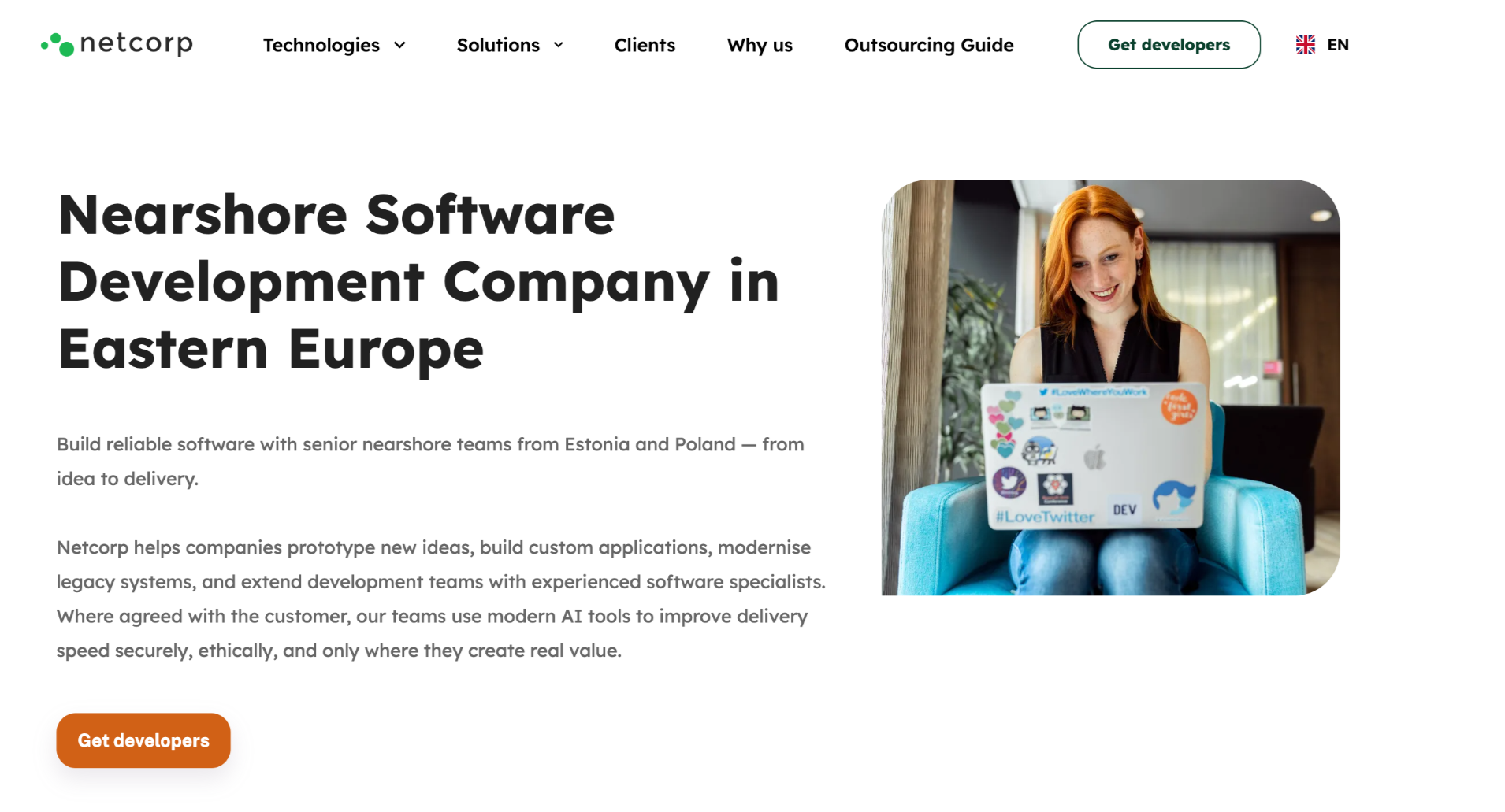
Best for: AI-powered software, AI integration, dedicated engineering teams, and end-to-end development
Polish presence: Gdańsk, Poland
Netcorp is a European software development company with engineering teams in Poland and Estonia. Its AI development services include AI agent development, custom AI models, AI-powered data analysis, and AI integration with existing software.
Its broader software engineering capabilities allow AI development to be combined with backend and frontend development, cloud infrastructure, DevOps, QA, and other technical disciplines. This can be useful when AI is part of a larger application rather than a standalone experiment.
Netcorp supports both team extension and full software projects. Its team extension services can suit businesses that already have an internal technology team but need additional specialists, while its software project services are geared toward complete product delivery.
For businesses comparing AI partners in Poland, this combination of AI expertise and broader software engineering makes Netcorp a practical starting point, particularly for projects that require both development and AI integration.
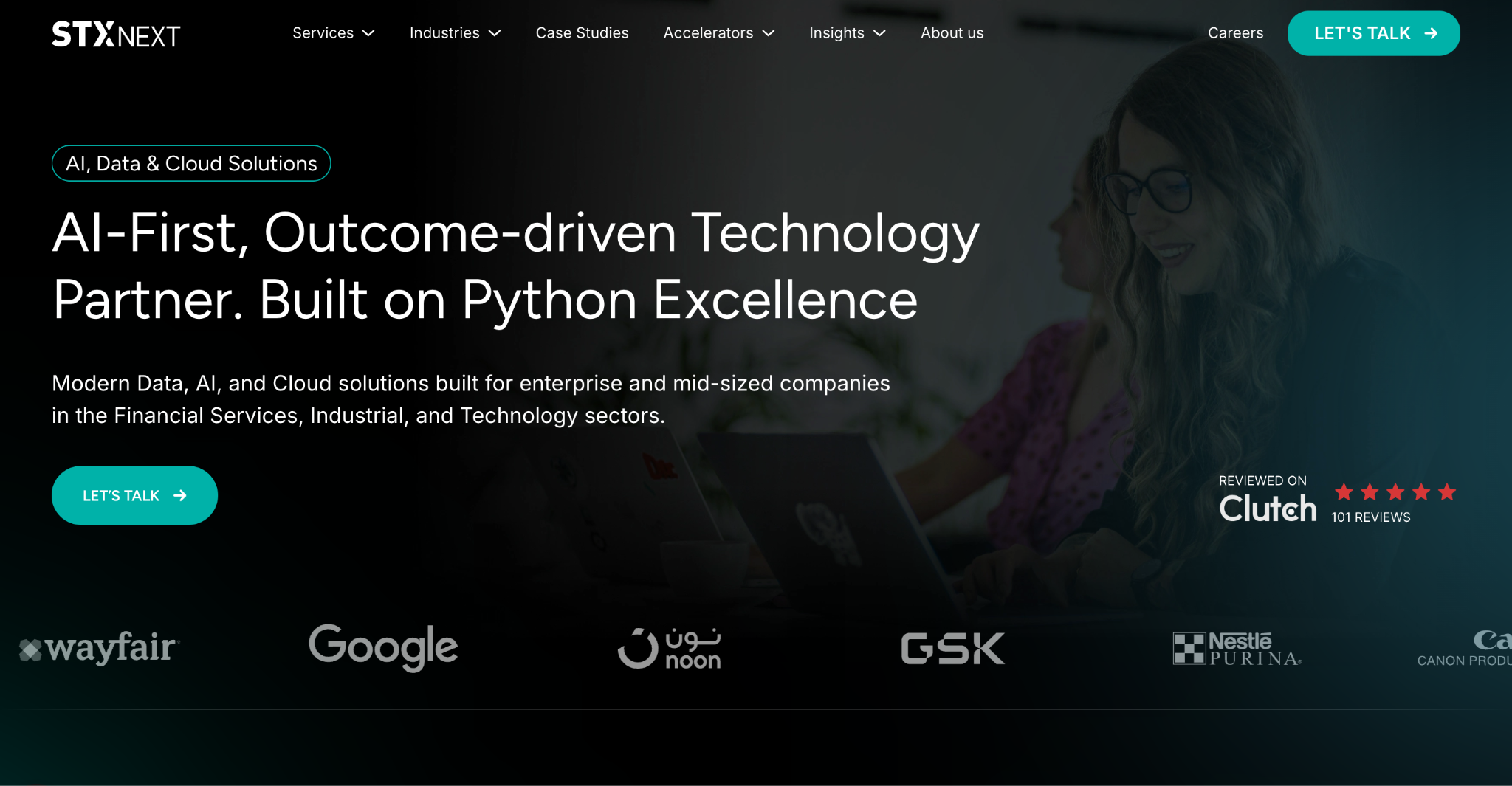
Best for: Enterprise AI, machine learning, data engineering, and AI agents
Headquarters: Poznań, Poland
STX Next is a software engineering company headquartered in Poznań. Its current services include AI development, machine learning, data engineering, AI agents, enterprise RAG, and AI-augmented software development.
Its AI development services cover discovery, proof of concept, production development, and ongoing support. The company also highlights work in banking, insurance, healthcare, manufacturing, energy, and other industries.
STX Next can therefore be relevant for organizations looking for AI expertise alongside established software engineering and data capabilities.
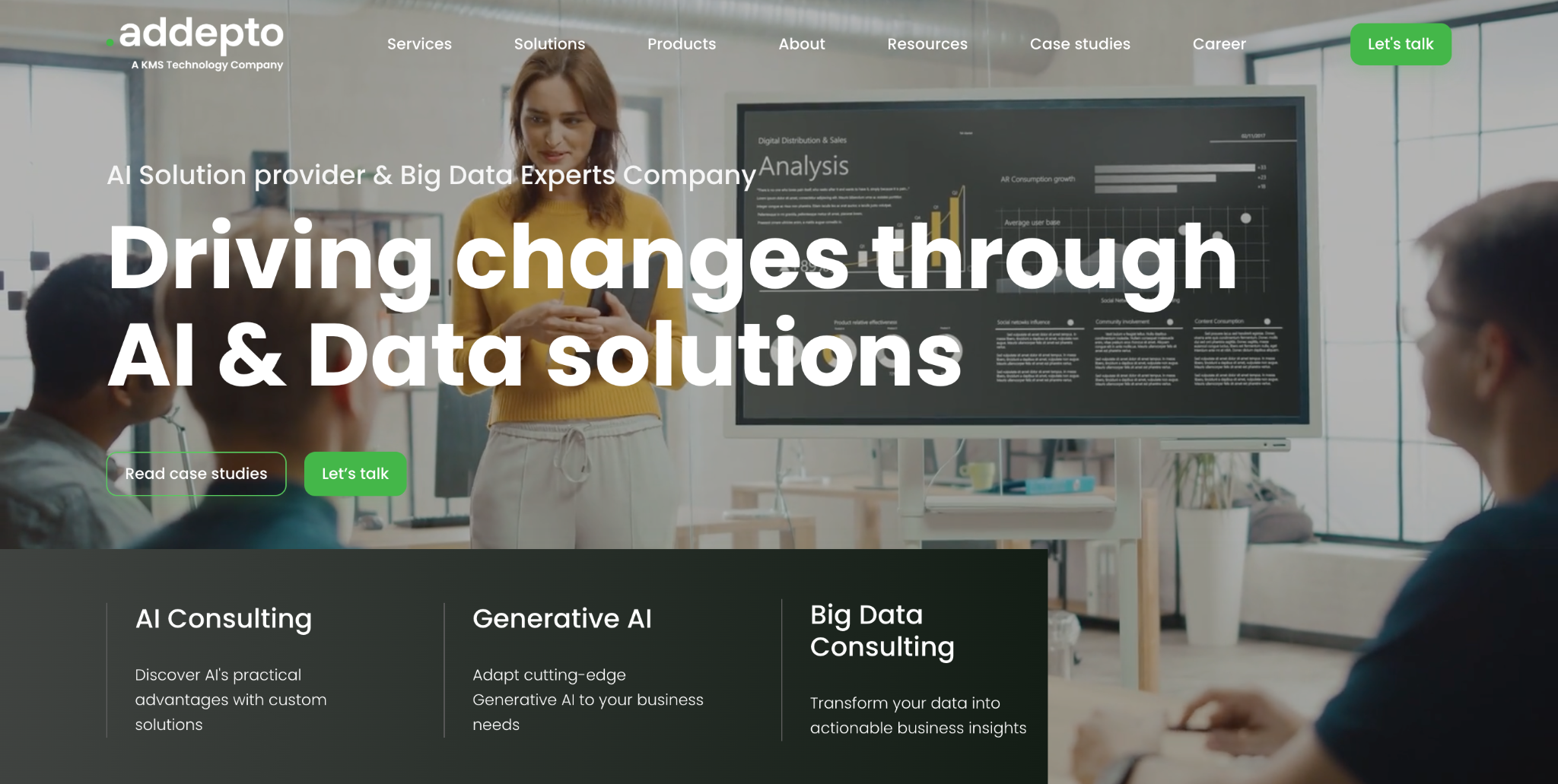
Best for: AI, Big Data, generative AI, and machine learning
Headquarters: Warsaw, Poland
Addepto is a Warsaw-based technology company focused on AI and Big Data. Its services include machine learning, generative AI, data engineering, analytics, MLOps, and AI consulting.
The company's offering places significant emphasis on the data infrastructure behind AI systems, including data integration, processing, and analytics. Its generative AI services also cover LLM-based applications and AI integration.
Addepto may be a good fit for organizations where AI development and data engineering need to be handled together.
Best for: AI-native product development and AI-augmented software engineering
Headquarters: Gliwice, Poland
Boldare is a Polish digital product development company headquartered in Gliwice, with offices in Warsaw, Wrocław, and Kraków. Its current offering includes AI product development and AI-augmented development.
Rather than treating AI only as a product feature, Boldare also integrates AI into the software development lifecycle, including development, testing, code review, and DevOps.
This makes the company relevant to organizations looking to build digital products while incorporating AI throughout the development process.
Best for: Generative AI and custom AI applications
Headquarters: Gdańsk, Poland
Neoteric is a software development company based in Gdańsk with a strong focus on AI and generative AI. Its broader services include digital product development and custom software engineering.
The company's AI work covers areas including generative AI, large language models, retrieval-augmented generation, and AI-powered applications. This makes it a relevant option for businesses looking to build or integrate modern generative AI capabilities.
Best for: LLM applications, RAG, AI agents, and B2B software
Polish presence: Poland
SoftKraft is a Poland-based software development company that focuses heavily on B2B software and engineering. Its AI capabilities include AI solution design, AI software development, automation, LLM applications, RAG, and AI agents.
Its approach is particularly relevant for businesses that need AI integrated with existing applications, cloud systems, or internal workflows rather than built as an isolated product.
Best for: Enterprise AI, machine learning, and computer vision
Headquarters: Gliwice, Poland
Future Processing is a long-established software development company headquartered in Gliwice. Its capabilities include AI, machine learning, computer vision, data, cloud, and enterprise software development.
The company's AI offering spans areas such as machine learning, computer vision, image processing, and AI adoption. Its broader enterprise experience can be useful when AI needs to work with existing systems and complex technology environments.
Best for: AI-powered digital products and product development
Headquarters: Wrocław, Poland
Monterail is a Wrocław-based software product development company offering web, mobile, product design, and AI-related services. Its established product-development background allows AI capabilities to be combined with application engineering and UX.
The company works across industries including healthcare, fintech, and e-commerce, making it relevant for projects where AI must fit into a broader digital product.
Best for: AI combined with software engineering, data, and cloud
Polish presence: Rzeszów, Poland
Edvantis is an international software engineering company with an established presence in Rzeszów. Its services cover software engineering, AI, data and analytics, cloud, digital transformation, and team augmentation.
This broader technical offering can be useful for businesses that need to combine AI capabilities with existing software development. Edvantis also publishes practical research on AI-assisted software engineering and the challenges of applying AI coding tools to real-world codebases.
Best for: Enterprise AI, industrial AI, and large-scale implementations
Poland: Nationwide presence
Sii Poland provides AI and software engineering services for organizations across multiple industries. Its current AI practice reports 350+ AI specialists and industry experts and 70+ AI production deployments, covering areas such as generative AI, agentic AI, computer vision, NLP, and data science.
The company focuses on moving AI from experimentation into production, making it particularly relevant for large organizations with complex implementation and governance requirements.
Choosing an AI partner should go beyond looking at whether a company offers machine learning or generative AI. Consider whether its experience matches your specific use case.
Look at its AI expertise, data engineering capabilities, production experience, security practices, and ability to integrate AI with existing systems. It is also worth asking how the team handles testing, monitoring, model updates, and ongoing maintenance.
Your preferred engagement model matters too. A company may provide a complete project team, individual specialists, or a combination of external and internal engineers.
Poland has an established software engineering market and a growing focus on advanced digital technologies. At the same time, business AI adoption remains below the EU average.
According to Eurostat, 8.4% of enterprises with 10 or more employees in Poland used AI technologies in 2025, compared with 20% across the EU. Poland's figure increased from 5.9% in 2024.
The European Commission's 2026 Digital Decade Country Report for Poland says Poland continues to lag in business digitalisation and advanced technology adoption, particularly among SMEs, while highlighting greater policy attention to areas such as AI infrastructure.
For companies looking for external expertise, this creates an opportunity to work with Polish engineering teams while avoiding the need to build every AI capability internally.
The global AI market is moving rapidly. Stanford University's 2026 AI Index Report reports that 88% of surveyed organizations used AI in at least one business function in 2025, while generative AI was used in at least one business function by 79%. AI-agent deployment, however, remained in the single digits across nearly all individual business functions.
These figures show that experimentation and adoption are advancing quickly, but organizations still face challenges when moving AI into broader production use.
AI development can involve building machine learning models, computer vision systems, NLP applications, generative AI, or AI agents.
AI-powered software development goes a step further by integrating those capabilities into an actual software product or business process.
Examples include:
For many businesses, this approach is more practical than developing a completely new AI model from scratch.
A typical AI project starts by defining the business problem and assessing available data.
The next steps may include:
The exact process varies according to the complexity of the project and the type of AI being implemented.
There is no standard price for AI development. Costs depend on the technology, project scope, data requirements, team size, integrations, infrastructure, security requirements, and ongoing maintenance.
A simple AI integration can require far less development work than a custom machine learning platform or enterprise AI application.
For this reason, it is generally more useful to compare providers based on scope, expected outcomes, technical expertise, and total project cost rather than hourly rates alone.
Building internally gives businesses direct control and can work well when they already have experienced AI and engineering teams.
Outsourcing can provide access to specialists without the time and cost of building a large AI team from scratch.
A hybrid model is another option. Businesses can keep product ownership and strategic decision-making internally while using an external team for AI engineering or additional software development capacity. Netcorp's staff augmentation model is designed for this type of collaboration.
Poland offers a growing range of companies specializing in AI, data, and software engineering. Netcorp is a strong option for businesses that want to combine AI development with broader software engineering and flexible team models, while STX Next, Addepto, Boldare, and Neoteric offer different strengths across enterprise AI, Big Data, product development, and generative AI.
The best partner depends on your specific requirements. Compare providers based on relevant AI expertise, production experience, security, engineering capabilities, scalability, and ongoing support to find a company that can deliver a reliable and maintainable solution.
Compare providers based on relevant AI experience, technical skills, security, communication, scalability, and ongoing support.
Yes. AI can be integrated into websites, SaaS platforms, mobile apps, CRMs, ERPs, and other existing systems.
Yes. Many providers work with LLMs, RAG, generative AI, AI agents, and related technologies.
A prototype validates an idea, while a production system must also be secure, scalable, reliable, tested, and maintainable.
Yes. Smaller businesses can start with a focused AI project or use an external team instead of building a large in-house AI department.
Yes. Many providers offer consulting to identify suitable use cases, assess infrastructure, and plan implementation.
Not necessarily much. A development partner can handle the technical work while the client provides business requirements, goals, and relevant data.
No. AI agents are most useful for multi-step workflows and tasks involving tools or connected systems. Simpler solutions may be more appropriate for other use cases.


Paavo Pauklin is a renowned consultant and thought leader in software development outsourcing with a decade of experience. Authoring dozens of insightful blog posts and the guidebook "How to Succeed with Software Development Outsourcing," he is a frequent speaker at industry conferences. Paavo hosts two influential video podcasts: “Everybody needs developers” and “Tech explained to managers in 3 minutes.” Through his extensive training sessions with organizations such as the Finnish Association of Software Companies and Estonian IT Companies Association, he's helped numerous businesses strategize, train internal teams, and find dependable outsourcing partners. His expertise offers a reliable compass for anyone navigating the world of software outsourcing.


Comprehensive web application development, including front-end, back-end, and full-stack.
User interface and user experience design services to create intuitive, engaging, and functional digital products.
Cloud infrastructure setup and automation for scalable, efficient software delivery using DevOps methodologies.

Comprehensive quality assurance services, including test automation, manual testing, performance testing.
