
Generative AI has moved beyond simple chatbots and content generators. Businesses now use large language models (LLMs), retrieval-augmented generation (RAG), AI agents, multimodal systems, and AI-powered automation inside real products and workflows.
Choosing a generative AI development company therefore requires more than checking whether a provider lists “AI” on its website. You need to consider its GenAI expertise, software engineering capabilities, experience with production systems, and ability to integrate AI into your existing technology stack.
Below is an editorial shortlist of generative AI development companies worth considering in 2026, based on current capabilities, project experience, specialization, and publicly available company information.
We evaluated providers based on:
This is an editorial shortlist rather than an absolute industry ranking. Companies are included based on their documented capabilities, experience, and relevance to different generative AI development needs.
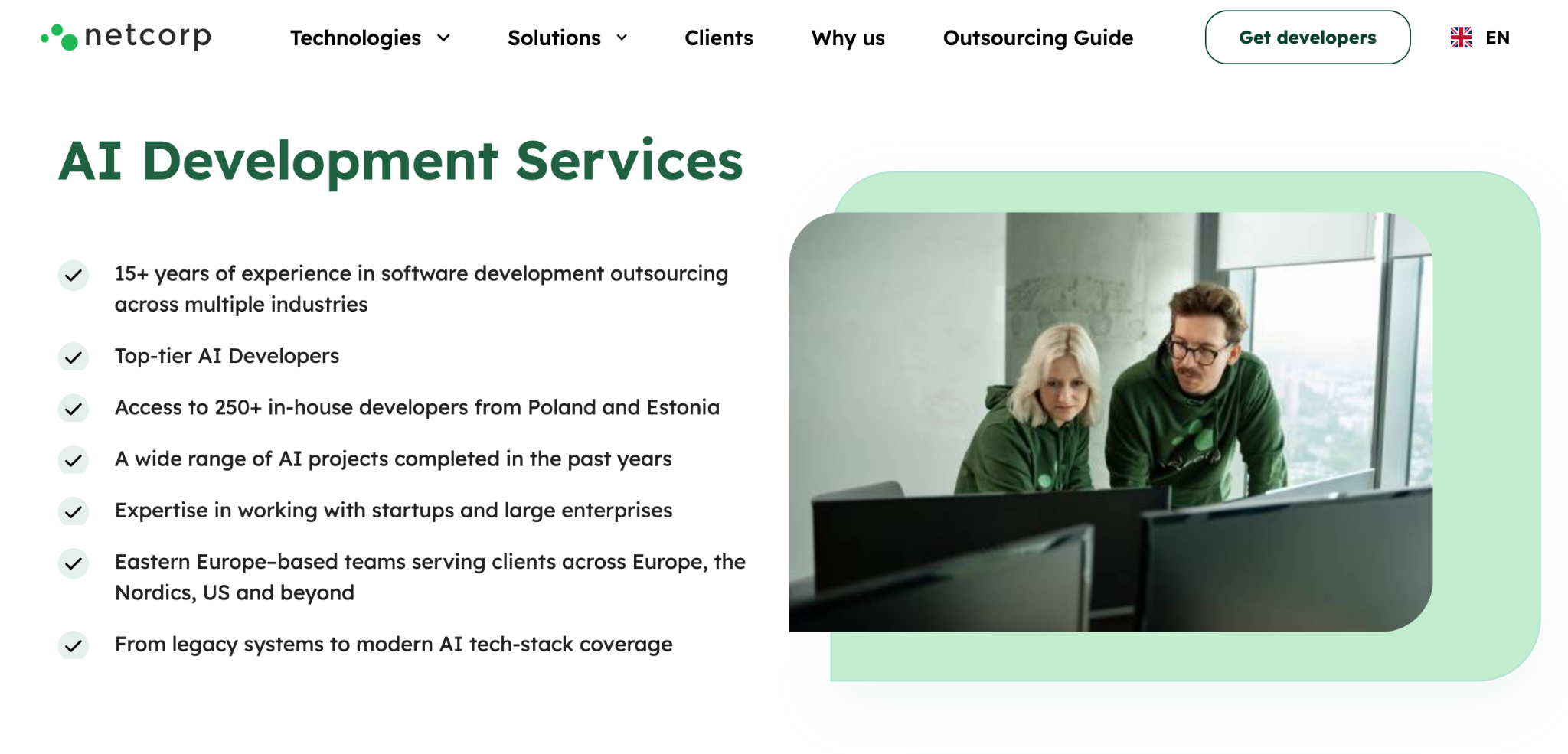
Best for: End-to-end generative AI development, AI integration, and AI agents
Netcorp combines generative AI development with broader software engineering, making it suitable for businesses that need AI embedded into an existing product rather than delivered as a standalone demo. Its current AI offering covers AI development services, AI agent development, generative AI, NLP, machine learning development, AI-powered data analysis, and AI integration.
Its AI agent practice specifically covers LLMs, RAG, orchestration, and integration with business systems. Netcorp also works with both startups and larger enterprises and provides access to 250+ in-house developers across Poland and Estonia.
For businesses evaluating the difference between experimentation and production implementation, Netcorp also covers practical AI engineering issues in its 2026 guide to AI-assisted software development.
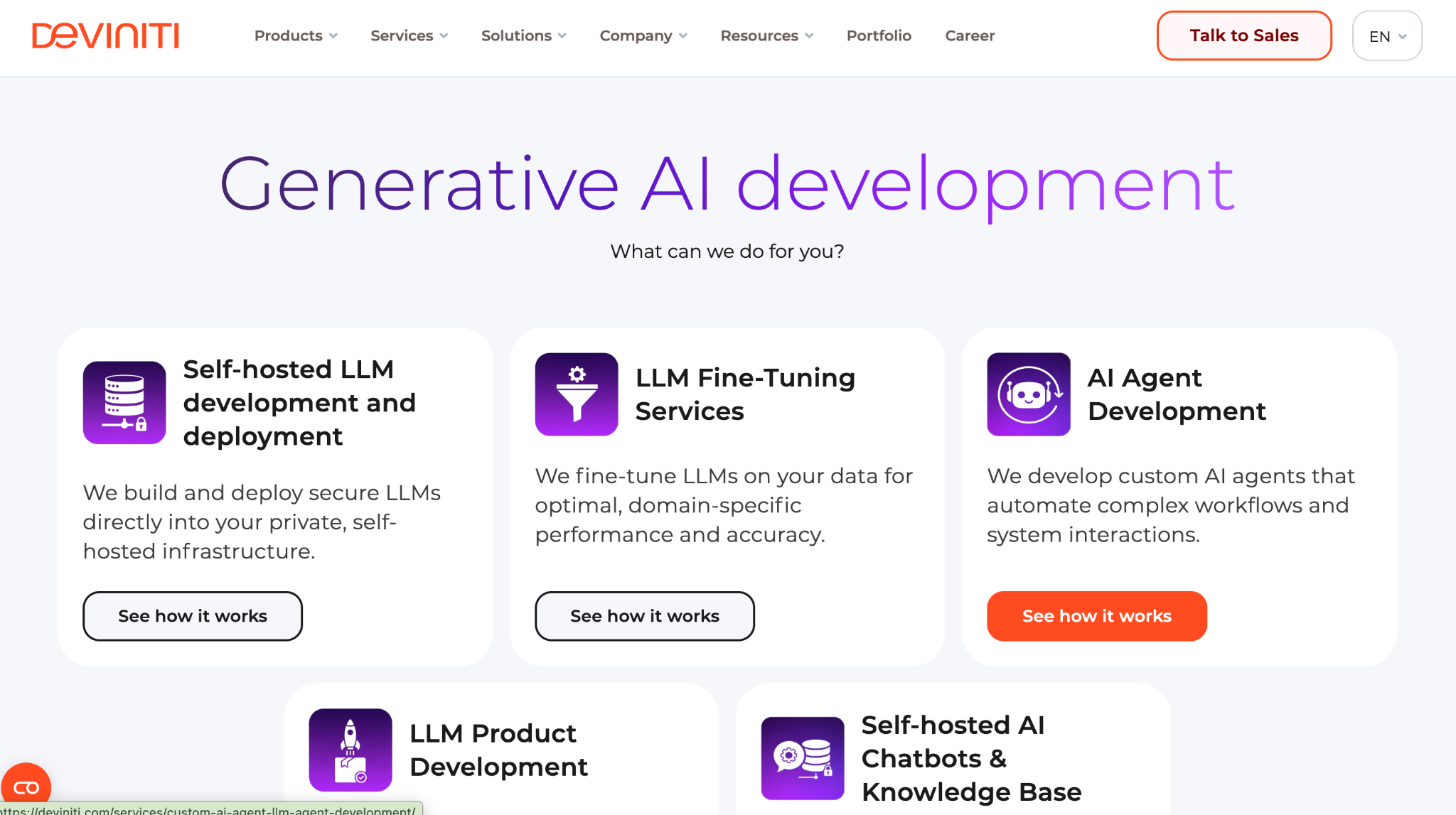
Best for: Enterprise GenAI, AI agents, and secure AI applications
Deviniti focuses on AI development and consulting for businesses that need generative AI integrated into enterprise environments. Its capabilities include AI agents, large language models, and secure AI applications, with an emphasis on building solutions that can work with business data and existing systems.
The company is particularly relevant for organizations exploring enterprise AI assistants, automated workflows, AI-powered internal tools, and proof-of-concept solutions before moving toward broader implementation.
Best for: Generative AI consulting, RAG, and AI application development
Neoteric combines generative AI consulting with custom software development, helping businesses identify suitable AI use cases and turn them into working applications. Its capabilities include LLM-based systems, RAG, generative AI applications, and AI strategy.
Its broader software engineering background also makes it suitable for companies that need to connect GenAI with existing products, data sources, and business workflows.
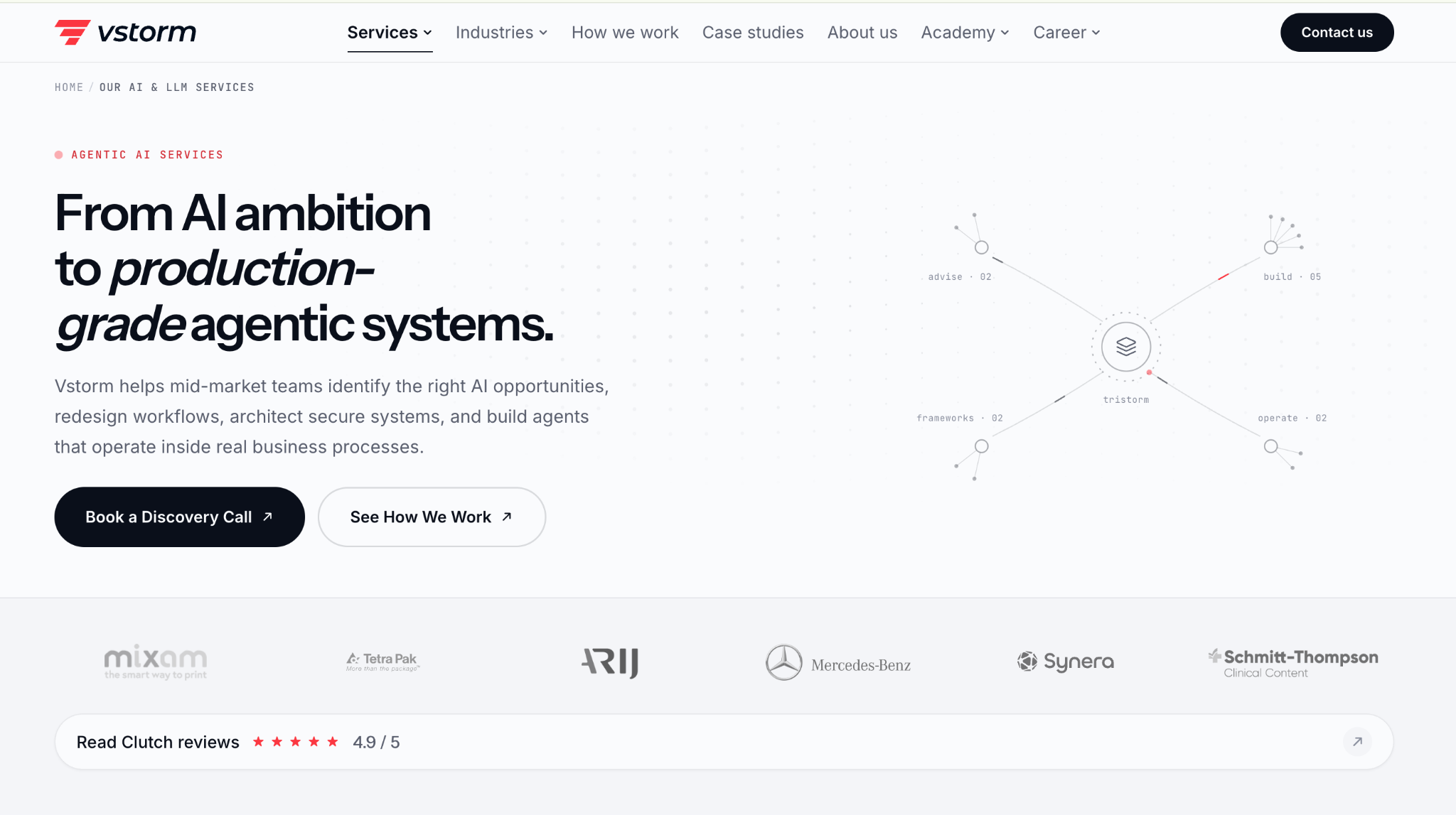
Best for: AI agents, LLM applications, and automation
Vstorm has a strong focus on AI agents and LLM-based applications, with an emphasis on automating multi-step business processes. Its approach goes beyond basic chatbots by connecting AI models with tools, data, and workflows.
The company can be relevant for businesses exploring AI-powered automation, intelligent assistants, agentic workflows, and systems that can perform tasks across connected applications.
Best for: GenAI combined with broader software engineering
STX Next combines AI development, generative AI, data engineering, and custom software development. This makes it suitable for organizations that want to add GenAI capabilities while also developing or modernizing the surrounding software infrastructure.
Its broader engineering expertise can support projects involving LLM applications, AI-powered products, data platforms, enterprise software, and integrations with existing systems.
Best for: Conversational AI, AI agents, and customer-facing GenAI
Master of Code Global focuses on conversational AI, generative AI, and AI-agent development, with applications across customer-facing digital experiences. Its capabilities include AI-powered assistants, voice solutions, and custom software.
The company is particularly suited to projects where GenAI needs to interact directly with customers, such as virtual assistants, automated customer support, conversational commerce, and voice-enabled applications.
Best for: Research-driven AI and production GenAI products
Tooploox combines AI research, software engineering, and product development, covering generative AI alongside machine learning, NLP, and computer vision.
Its approach is well suited to companies developing new AI-powered products, experimenting with advanced AI use cases, or turning AI concepts and prototypes into production-ready applications.
Best for: GenAI, data engineering, and AI consulting
Addepto combines generative AI with AI consulting, machine learning, analytics, and Big Data engineering. This makes it particularly relevant when a GenAI application depends heavily on structured or unstructured business data.
Its capabilities can support projects involving RAG systems, AI-powered analytics, enterprise knowledge solutions, LLM applications, and data-intensive AI products.
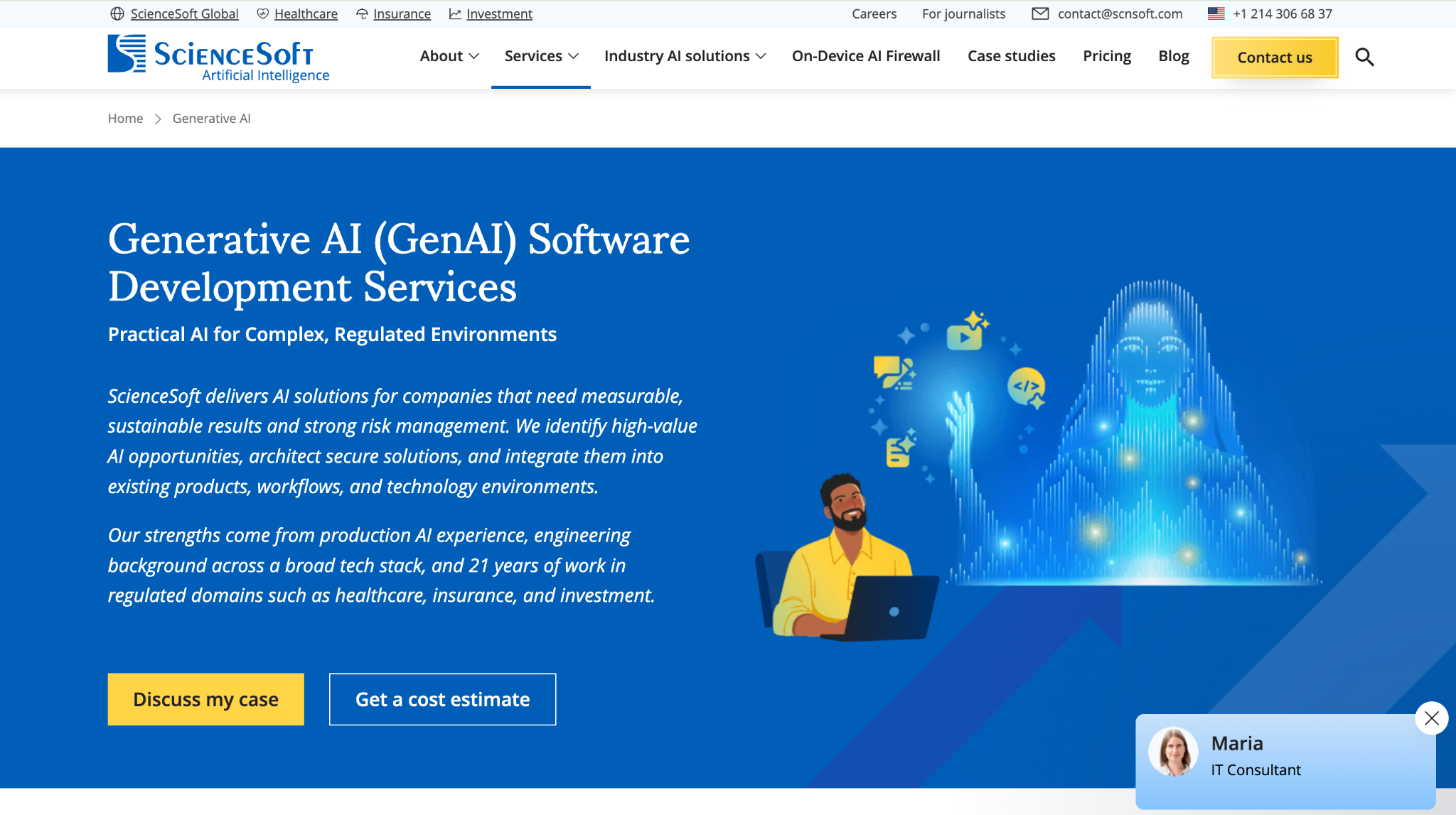
Best for: Enterprise AI modernization and complex software environments
ScienceSoft offers a broad range of technology services alongside AI development, generative AI, and AI agents. Its wider software engineering capabilities make it suitable for businesses with complex or established technology environments.
The company can support AI modernization, intelligent automation, enterprise applications, AI integrations, and generative AI solutions that need to work with existing systems and infrastructure.
Best for: Large-scale software engineering with GenAI integration
Intellias combines custom software engineering with AI, data, cybersecurity, and managed services. Its generative AI capabilities can therefore be integrated into larger digital transformation and software development initiatives.
It is particularly relevant for organizations building enterprise AI applications, AI-powered business processes, intelligent software features, and GenAI solutions that need to operate within complex technology ecosystems.
A generative AI development company builds and integrates systems that use AI models to generate or transform text, images, audio, code, or other content.
Typical projects include:
The difference between a GenAI demo and a production system is often the surrounding engineering: data access, security, evaluation, monitoring, integrations, and maintenance. Netcorp's AI development services cover these broader implementation needs, while its AI agent development services focus specifically on agent-based automation.
Look beyond the model a company says it uses. A strong partner should be able to explain:
It's also worth examining real project examples rather than relying only on AI service pages. Netcorp's AI in Software Development article provides additional context on how AI is being applied across modern software engineering.
There is no single price for a GenAI project. Cost depends on the model or models involved, data requirements, integrations, security requirements, interface complexity, infrastructure, and ongoing maintenance.
A small internal RAG assistant can require significantly less engineering than an enterprise AI agent connected to multiple systems and workflows. The best way to compare proposals is therefore to evaluate scope, technical approach, expected outcomes, and total delivery cost, rather than hourly rates alone.
Studies show that generative AI can improve productivity, but results vary by task and implementation. An NBER study on generative AI at work found a 14% average productivity increase in customer support, while a METR study of experienced software developers found that early AI coding tools increased completion time by 19% in its specific test setting.
These findings highlight why successful GenAI projects require more than choosing a model — they also depend on the right use case, data, integration, evaluation, and implementation strategy.
The right generative AI development company depends on what you're building and how deeply AI needs to integrate with your business. Some providers specialize in agents or RAG, while others combine GenAI with broader software engineering, data, cloud, and enterprise modernization.
For businesses that need both generative AI expertise and broader software engineering, Netcorp provides AI development, generative AI, AI agent development, machine learning, and integration capabilities through teams based in Eastern Europe.


Paavo Pauklin is a renowned consultant and thought leader in software development outsourcing with a decade of experience. Authoring dozens of insightful blog posts and the guidebook "How to Succeed with Software Development Outsourcing," he is a frequent speaker at industry conferences. Paavo hosts two influential video podcasts: “Everybody needs developers” and “Tech explained to managers in 3 minutes.” Through his extensive training sessions with organizations such as the Finnish Association of Software Companies and Estonian IT Companies Association, he's helped numerous businesses strategize, train internal teams, and find dependable outsourcing partners. His expertise offers a reliable compass for anyone navigating the world of software outsourcing.


Comprehensive web application development, including front-end, back-end, and full-stack.
User interface and user experience design services to create intuitive, engaging, and functional digital products.
Cloud infrastructure setup and automation for scalable, efficient software delivery using DevOps methodologies.

Comprehensive quality assurance services, including test automation, manual testing, performance testing.
